
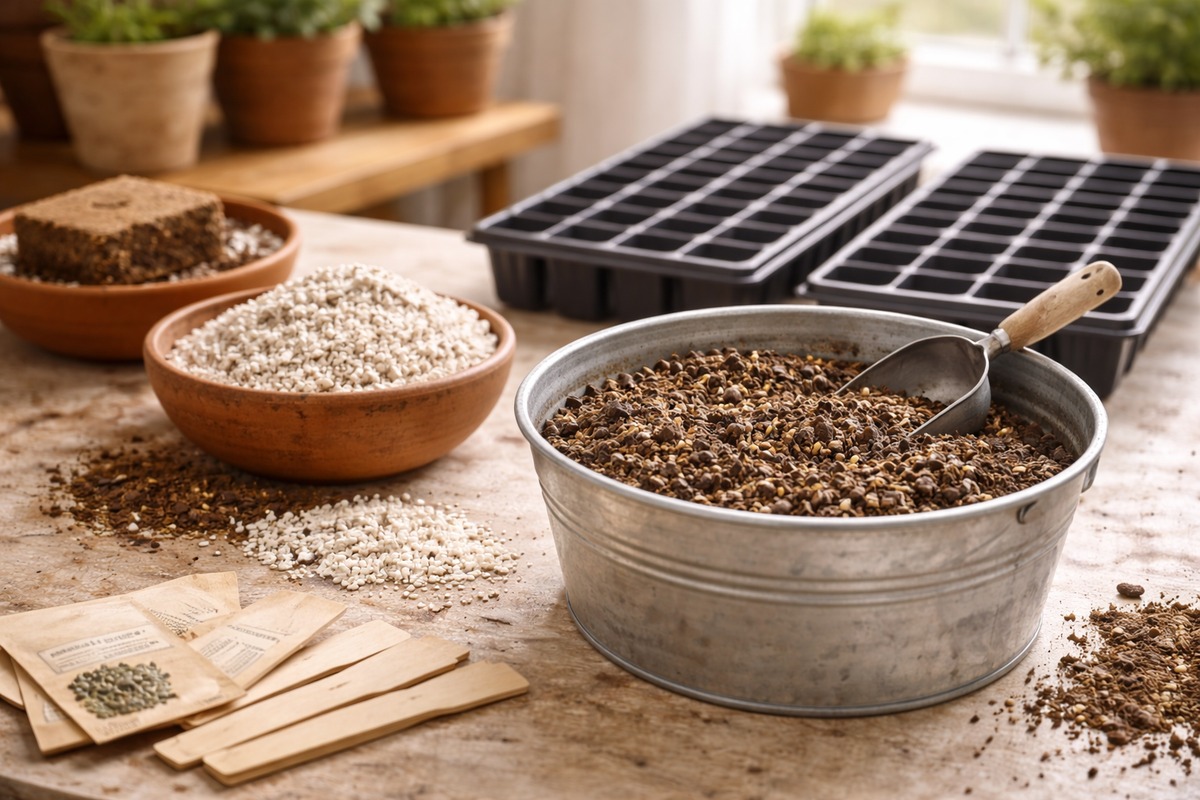
Why seed-starting mix matters so much
Seedlings don’t need rich soil at first—they need a mix that helps them:
- germinate evenly
- grow roots fast
- avoid rot and mold
- stay moist without staying soggy
The wrong mix causes almost every classic seed-starting frustration: damping-off, fungus gnats, slow growth, and tiny weak roots.
The 4 things a good seed-starting mix must do
When I’m choosing or mixing seed-starting media, I look for these four traits:
1) Light + airy structure
Seeds and tiny roots need oxygen. Heavy mixes pack down, hold too much water, and suffocate seedlings.
2) Even moisture retention
The mix should hold moisture like a sponge—but not turn into mud.
3) Fast drainage
Extra water must drain out quickly so the surface doesn’t stay wet for days.
4) Fine texture (for small seeds)
Tiny seeds need good contact with the mix, so big bark chunks can be a problem early on.
What NOT to use (common mistakes)
Garden soil
It’s too dense indoors, often brings pests, and can compact hard.
“Topsoil” bags
Usually heavy, inconsistent, and not designed for containers.
Chunky potting mixes with big bark pieces (for tiny seeds)
They can create air gaps that dry out seeds before they sprout.
Note: Potting mix can work if it’s fine-textured and drains well—but many don’t.
Store-bought seed starting mix vs. potting mix
Seed starting mix
- lighter and finer
- usually lower in nutrients
- designed for germination + early root growth
Potting mix
- often chunkier
- may hold too much water indoors
- can be great later when seedlings are potted up
My approach: I use seed starting mix for germination and early weeks, then I pot up into a good potting mix once seedlings have true leaves and stronger roots.
The key ingredients (what each one does)
Even if I’m buying a bag, knowing ingredients helps me choose better.
Peat moss or coco coir (moisture + structure)
- Peat moss holds moisture well and is common in seed mixes.
- Coco coir is a renewable alternative that also holds moisture well.
Either can work. The bigger factor is whether the final mix drains well.
Perlite or pumice (air + drainage)
These add air pockets and prevent compaction.
- If my mix stays too wet, I add more perlite.
Vermiculite (gentle moisture holding)
Vermiculite holds water and can help germination, but too much can make a mix stay wet.
Compost (nutrition)
Compost can help once seedlings are established, but for germination it’s optional.
- Too much compost early can increase fungus/mold issues.
My simple DIY seed-starting mix (easy + forgiving)
If I want a DIY blend, I keep it simple.
Basic DIY blend (good for most seeds)
- 2 parts coco coir (or peat)
- 1 part perlite
- 1 part vermiculite
This gives me:
- fine texture
- good moisture holding
- better drainage than “straight coir”
“Dries too fast” tweak
If my trays dry quickly, I slightly increase vermiculite:
- 2 parts coir/peat
- 1 part perlite
- 1.5 parts vermiculite
“Stays too wet” tweak
If my mix stays soggy, I increase perlite:
- 2 parts coir/peat
- 1.5 parts perlite
- 0.5–1 part vermiculite
Pre-moistening: the step that prevents dry pockets
Dry seed-starting mix can be hard to wet evenly.
Here’s what I do:
- Put mix in a tub or bucket
- Add water slowly and stir
- Aim for “wrung-out sponge” texture:
- damp enough to clump in my hand
- not dripping water when squeezed
Pre-moistening helps seeds germinate more evenly and prevents random dry cells.
Do seedlings need fertilizer in seed starting mix?
Most seeds have enough stored energy to sprout and make the first leaves. I usually don’t worry about fertilizer until:
- the plant has true leaves, and
- it’s been growing a couple of weeks
If I’m using a very “bare” seed mix, I start light feeding later (not at germination).
Common mix problems (and quick fixes)
Problem: mix grows mold on top
Likely: surface staying wet + low airflow
Fix:
- bottom water
- increase airflow
- let the surface dry slightly between waterings
Problem: mix dries out too fast
Likely: too much perlite / warm dry room
Fix:
- add a bit more moisture-holding ingredient (vermiculite/coir)
- bottom water more consistently
Problem: mix stays wet and seedlings stall
Likely: not enough drainage / too much vermiculite / compacted mix
Fix:
- add perlite
- avoid pressing mix down hard
- make sure containers drain fully
Sterile vs. “living” mix: what I do
Some people prefer sterile seed mix to reduce disease risk. Others want a more living soil.
My practical approach:
- for beginner seed starting indoors, I prioritize clean + consistent
- I can always introduce richer soil later when potting up
When I pot up to a different mix
Once seedlings have:
- 1–2 sets of true leaves
- roots filling the cell
- steady growth
…I pot up into a higher-quality potting mix (often with a bit of compost). That’s when nutrition matters more.
FAQ
Can I start seeds in regular potting mix?
Sometimes, yes—if it’s fine-textured and drains well. If it’s chunky or stays wet, I’ll fight problems.
Is coco coir better than peat?
Both can work. Drainage + airflow matter more than the label.
Should I add compost to seed starting mix?
For germination, not necessary. I add nutrients later when seedlings are stronger.
Quick wrap-up
A great seed-starting mix is:
- light
- evenly moist
- fast draining
- fine textured
And with one simple DIY blend, I can control the results instead of guessing what’s in the bag.