
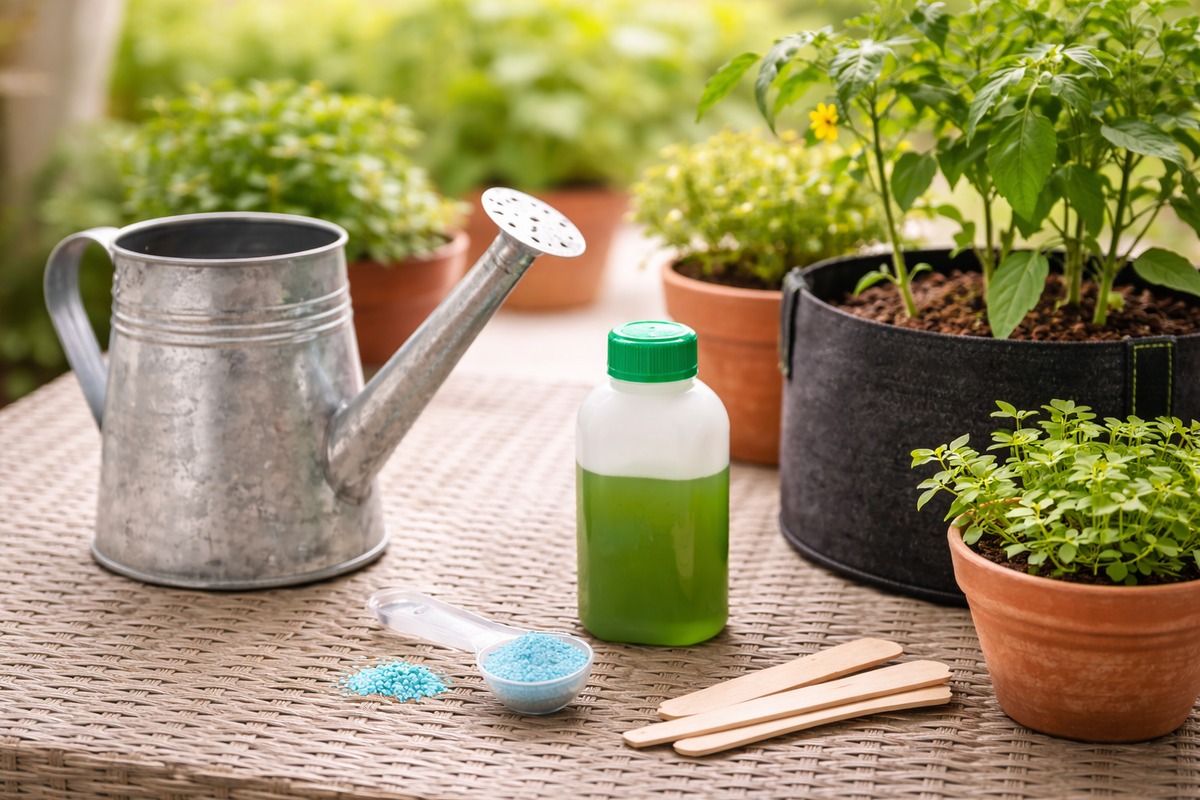
Why fertilizing containers is different than in-ground beds
In the ground, plants can spread roots and tap into new nutrients. In a pot, they’re stuck with whatever I put in at planting time—and every deep watering slowly rinses nutrients out.
So container fertility is less about “one big feeding” and more about:
- steady nutrients over time
- small doses
- a routine I actually follow
If I don’t have a plan, I end up with the two classic problems:
- hungry plants mid-season
- panic feeding that burns roots
The 2 container fertilizing systems (pick one)
I keep it simple by choosing one of these systems and sticking with it.
System A: Slow-release fertilizer (lowest effort)
This is my “set it and mostly forget it” method.
How it works:
I mix a slow-release fertilizer into the potting mix at planting time. It releases nutrients gradually.
Best for:
- busy schedules
- mixed container gardens
- herbs and greens
- consistent, steady growth
Downside:
If a plant needs a quick boost, slow-release isn’t instant.
System B: Liquid fertilizer schedule (most control)
This gives me the best control for heavy feeders.
How it works:
I feed plants with a diluted liquid fertilizer regularly during growth.
Best for:
- tomatoes, peppers, cucumbers
- long-season container veggies
- fast growth periods (summer)
Downside:
It requires routine (but it’s easy once it becomes a habit).
My beginner recommendation
If I’m new to containers, I do this:
- slow-release at planting
- plus a light liquid feed later if the plant looks hungry
It’s forgiving and hard to mess up.
What “balanced” fertilizer means (in plain English)
Most fertilizers list N-P-K:
- N (nitrogen): leafy growth (greens, lush plants)
- P (phosphorus): roots + blooms (important early)
- K (potassium): overall plant health, flowering/fruiting
For most container veggies, I prefer a balanced fertilizer or a mild veggie-focused blend. I don’t need perfection—consistency matters more.
My simple container fertilizing schedule
This schedule works for most container gardens.
Week 0 (planting)
- Use quality potting mix
- Add slow-release fertilizer or plan for liquid feeding
Weeks 2–4 (after plants settle)
This is when many containers start to stall if I don’t feed.
If using slow-release:
- usually no change yet (but I watch the plant)
If using liquid fertilizer:
- start feeding every 7–14 days, diluted
Mid-season (heavy growth + fruiting)
This is when tomatoes and peppers really need steady nutrients.
- Continue liquid feed weekly (light doses)
- Or top up slow-release per label schedule
Late season
I keep feeding, but I don’t go crazy:
- consistent light feeding is better than big late doses
Crop-by-crop feeding approach (containers)
Herbs
Herbs don’t want endless nitrogen. Too much fertilizer can make them:
- grow soft and watery
- lose flavor
My herb plan:
- slow-release at planting OR
- light liquid feed every 3–4 weeks
Leafy greens
Greens like nitrogen, but I still feed gently.
My greens plan:
- slow-release + optional light liquid feed every 2–3 weeks
Tomatoes
Tomatoes in containers are heavy feeders.
My tomato plan:
- slow-release at planting
- plus liquid feed weekly once flowering starts
Peppers
Peppers like steady feeding, not huge spikes.
My pepper plan:
- slow-release + liquid feed every 7–14 days during fruiting
Cucumbers
Cucumbers are thirsty + hungry.
My cucumber plan:
- slow-release + weekly liquid feed in peak season
The “water first” rule (prevents fertilizer burn)
This rule saves me:
I never fertilize a bone-dry pot.
If soil is dry and I add fertilizer, salts can burn roots.
So I:
- water first
- feed after (or feed in the watering can)
Signs I’m underfeeding (common in containers)
- pale green leaves
- slow growth even in warm weather
- small leaves
- lower leaves yellowing
- poor flowering/fruit set
Underfeeding usually looks like “nothing is happening.”
Signs I’m overfeeding (the ones I watch for)
- burnt leaf edges (crispy brown tips)
- dark green leaves with weak, floppy growth
- lots of leaves but few flowers
- white crust on soil surface (salt buildup)
- sudden wilting even when soil is wet (root stress)
If I think I overfed, I:
- flush the container with plain water (let it drain well)
- pause feeding for 1–2 weeks
- resume at a weaker dose
Salt buildup: the hidden container problem
Fertilizer salts can accumulate in pots over time, especially if I always bottom-water or never flush.
What I do
Every few weeks, I water deeply from the top until extra drains out. This helps rinse salts and keeps roots happier.
Organic vs synthetic fertilizer (what I actually do)
Both can work.
- Organic tends to be slower and gentler
- Synthetic tends to be faster and easier to measure
My choice depends on what I can consistently do. I’d rather use a simple synthetic schedule correctly than buy “perfect organic” and forget it.
FAQ
Do I need a special “tomato fertilizer”?
Not necessarily. A balanced fertilizer works if I feed consistently. Tomato formulas can help, but routine matters more.
Can I compost-feed containers instead?
Compost helps, but it’s usually not enough alone for heavy-feeding container veggies.
How often should I fertilize?
Small, regular feedings (weekly or biweekly) are usually safer than big doses.
Quick wrap-up
Container fertilizing becomes easy when I:
- choose one system (slow-release or liquid)
- water first, then feed
- use small, consistent doses
- watch for under/overfeeding signs
That’s how I keep pots productive all season without stress.