
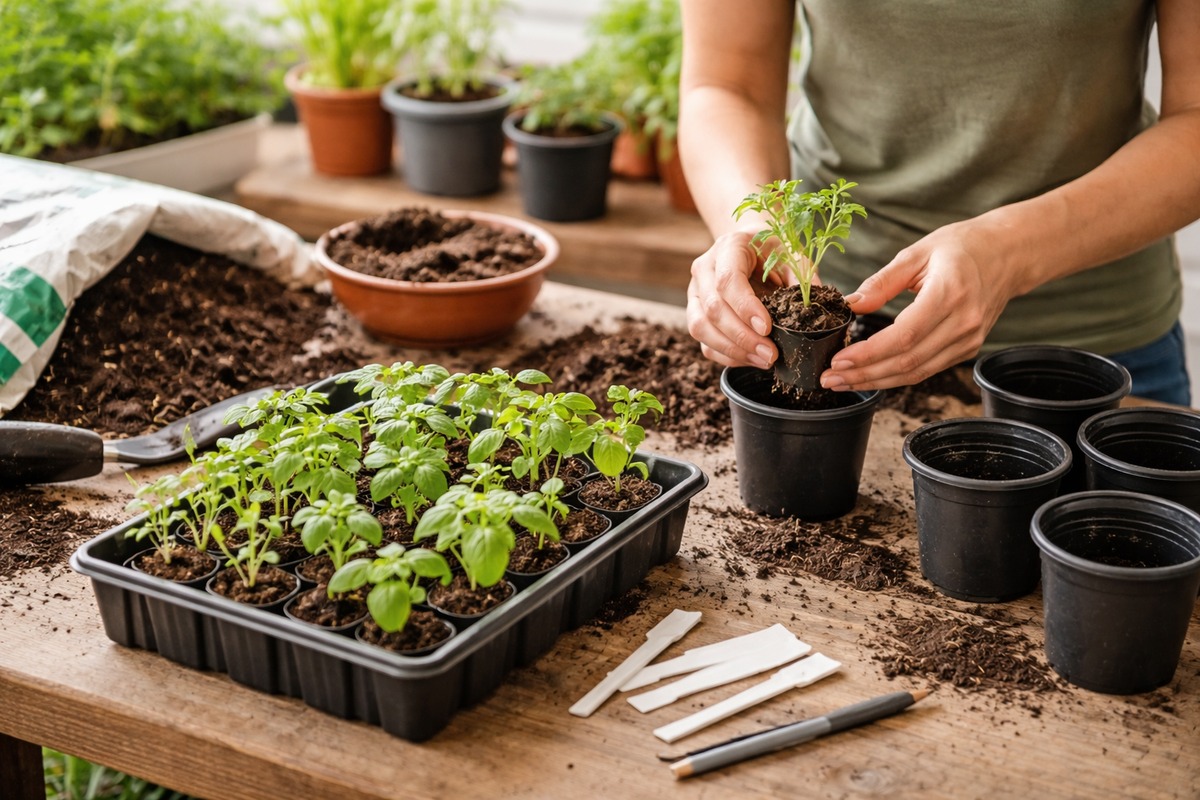
How to Pot Up Seedlings Before Transplanting Them Outdoors
Sometimes I start seeds on time, everything goes well, and then the weather refuses to cooperate. Or maybe the seedlings are growing faster than expected. Suddenly the little starter cells that looked perfectly fine a week ago are too small, and the plants are telling me they need more room.
That is where potting up comes in.
Potting up means moving a seedling from its original small cell or starter container into a larger pot before it goes outside. It is not something every seedling needs, but when a plant starts outgrowing its space, potting up can keep it healthy and prevent a lot of stress.
Why seedlings sometimes need to be potted up
Seed-starting trays are designed for early growth, not for keeping plants there forever. Small cells are convenient, but they only hold a small amount of soil. Once roots fill that space, the seedling can dry out faster, stall out, or become rootbound.
This often happens when:
- outdoor planting is delayed by weather
- I started too early
- the crop grows quickly
- the seedling already has several true leaves
- the roots are filling the cell
Potting up gives the plant fresh soil, more root room, and a little more time to grow steadily.
Signs a seedling needs a bigger pot
A seedling does not need to be huge before it needs more space. I look for a few simple clues:
- roots are coming out of the drainage hole
- the seedling dries out unusually fast
- growth seems to slow down
- leaves are getting large compared to the tiny cell
- the plant tips over easily because the top is larger than the root zone
- the weather is still not ready for transplanting outdoors
If I see several of these signs, potting up is usually the right move.
Which seedlings benefit most from potting up
Not every crop needs this step. Fast-growing or larger seedlings often benefit the most.
Common seedlings that may need potting up:
- tomatoes
- peppers
- basil
- zinnias
- many flowers started early
- brassicas if outdoor timing gets delayed
Small fast crops that are meant to move quickly outdoors may not always need it.
When to pot up
There is no perfect calendar rule, but a good time is when the seedling has developed a few sets of true leaves and is clearly outgrowing its starter space.
I try not to wait until the plant is severely rootbound. Potting up earlier is easier on the roots than waiting until the seedling is cramped and stressed.
What size pot should I use next?
I do not need to jump from a tiny cell into a giant pot. Usually I move up just one step.
A good beginner approach is:
- from a small starter cell into a 3-inch or 4-inch pot
- from a very small plug into something modestly larger
- large enough for more soil, but not so large that the mix stays wet forever
The goal is balance. I want more room, not a swampy oversized container.
What kind of mix to use
For potting up, I usually use a light, quality potting mix rather than dense garden soil. It should hold moisture but still drain well.
A seedling moving into a larger pot needs oxygen around the roots as much as it needs water.
How to pot up seedlings step by step
1. Water the seedlings first
It is easier to transplant seedlings when the root ball is slightly moist. Bone-dry soil falls apart, and soaking-wet soil can be messy.
2. Fill the new pot partway
Add enough potting mix so the seedling will sit at the right level when placed inside.
3. Gently remove the seedling
Squeeze or support the cell gently and ease the seedling out by the root ball, not by the stem.
4. Place it in the new pot
Set the seedling in the center and check the height before filling around it.
5. Add mix around the root ball
Firm gently, but do not pack the soil hard.
6. Water lightly after transplanting
This helps settle the mix around the roots.
7. Return it to good light
After potting up, the seedling still needs strong light and normal care.
Can I bury the stem deeper?
Sometimes, yes. Tomatoes are the classic example because they can form roots along buried stems. Many other seedlings should be planted at roughly the same level they were already growing.
When in doubt, I avoid planting much deeper unless I know the crop handles that well.
What happens after potting up
A healthy seedling may pause briefly, then resume growth once the roots begin exploring the new soil. During this stage, I watch watering carefully. A larger pot holds moisture longer than a tiny cell, so I do not want to overwater out of habit.
This is one of the most common beginner mistakes after potting up: treating the new pot like it dries out at the same speed as the old one.
Common potting up mistakes
Waiting too long
If roots are tightly packed and circling, the seedling may already be stressed.
Using a huge pot too soon
Too much wet soil around a small root system can slow growth.
Pulling by the stem
Seedling stems are delicate. I always handle the root ball when possible.
Overwatering afterward
Freshly potted seedlings need moisture, but not constantly soaked soil.
Forgetting light
Potting up does not solve weak light problems. Seedlings still need strong, close light.
Do all seedlings need potting up before going outside?
No. Many do just fine moving directly from starter cells to the garden if the timing works out well. Potting up is a useful middle step when seedlings need more time or more space before transplanting outdoors.
It is a tool, not a requirement.
Final thoughts
Potting up is one of the simplest ways to keep seedlings healthy when outdoor timing and indoor growth stop matching up. It gives roots more room, helps avoid stress, and can keep plants steady until it is finally time to transplant.
I do not need to overthink it. If a seedling is outgrowing its cell and the garden is not ready yet, a slightly larger pot is often exactly what it needs.