
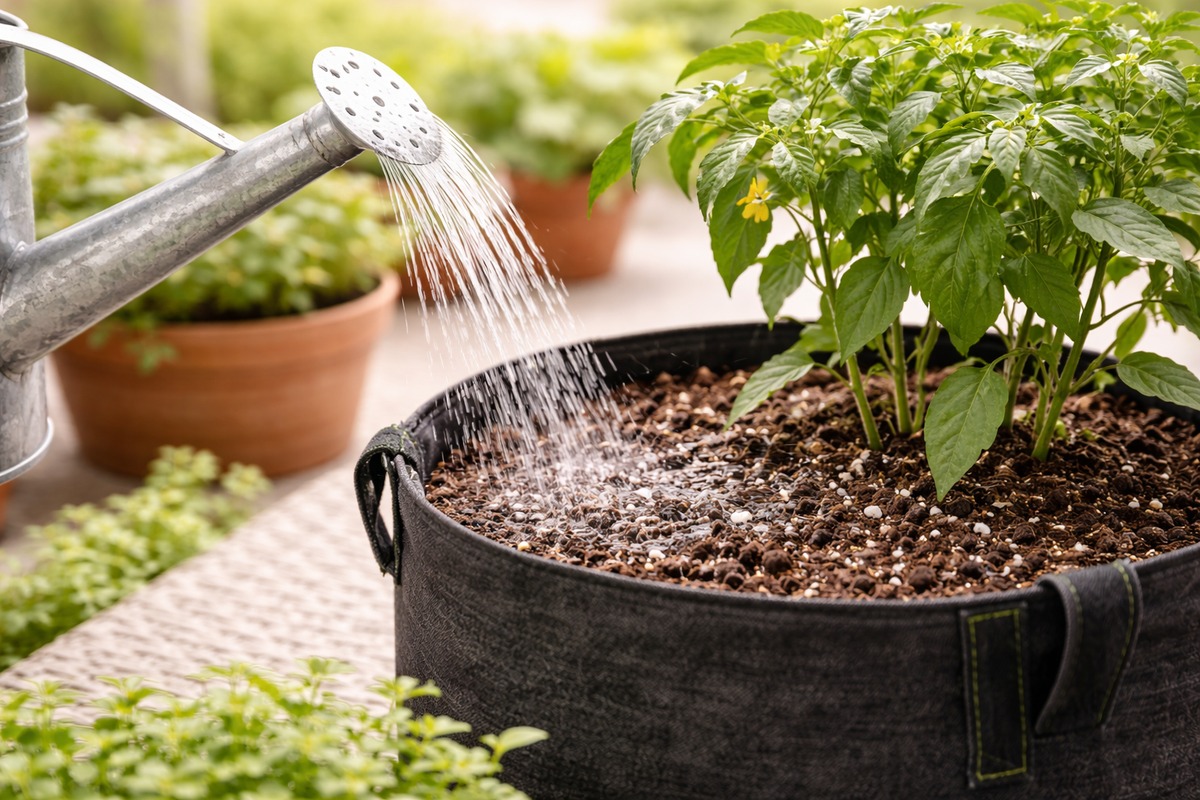
Why container watering feels hard (and how I simplify it)
Pots dry out faster than garden beds because:
- they have limited soil volume
- sun heats the container walls
- wind pulls moisture from leaves and soil surface
- well-draining mixes drain quickly (which is good, but needs a routine)
The mistake I used to make was watering on a schedule.
Now I water based on need, using a few fast checks.
The 3 container watering goals I aim for
- Even moisture (not constant wetness)
- Deep hydration (water reaches the full root zone)
- Oxygen for roots (no soggy, airless soil)
If I hit these three, container plants grow faster and stay healthier.
My “no-guess” container watering routine
This is the routine I follow most of the season.
Step 1) Do a quick check (30 seconds)
I use two of these checks before watering:
The weight test (best one)
I lift the pot slightly:
- heavy = I wait
- noticeably lighter = I water
The finger test
I stick a finger 1–2 inches into the mix:
- moist/cool = wait
- dry = water
The look test
If the surface is dry and pale and the pot feels light, it’s usually time.
Important: I don’t water just because the top looks dry. I check deeper or weight.
Step 2) Water deeply (not a little splash)
When I water, I water enough to:
- soak the root zone
- push air out of dry pockets
- and (usually) produce a little drainage
My rule: I water until I see a small amount drain from the bottom—then I stop.
If I only sprinkle the top, roots stay shallow and the plant becomes more dependent on frequent watering.
Step 3) Let it drain fully
I avoid leaving standing water:
- I empty saucers after 15–30 minutes outdoors
- indoors, I’m extra careful (standing water + low airflow = rot)
How often do container plants need water?
It depends on pot size, plant size, weather, and pot material. But here’s what’s normal:
- cool spring weather: every 2–4 days
- summer warmth: every 1–2 days
- peak heat + wind: sometimes daily (or twice daily for small pots)
That’s why I rely on checks, not a rigid schedule.
Morning vs evening watering (what I do)
Morning is my default
Morning watering:
- prepares plants for heat
- reduces stress midday
- lowers disease risk vs wet leaves overnight
Evening watering can help in extreme heat
If a plant is dangerously wilted at 6 pm:
- I water to prevent damage
But I avoid soaking foliage if disease is a concern.
Special situations that change my watering strategy
1) Heat waves
In heat waves, my goals are:
- deep watering early
- keep roots cooler
- reduce evaporation
What helps:
- move pots to afternoon shade if possible
- mulch the soil surface (even a thin layer)
- group pots together (less wind exposure)
- use larger containers whenever possible
2) Windy balconies
Wind can dry plants faster than heat.
What helps:
- windbreaks (even a screen)
- heavier pots (less tipping)
- consistent deep watering
- mulch on top
3) Fabric grow bags
Fabric bags breathe, which is great—but they dry faster.
My approach:
- water more deeply
- check more often
- use mulch and bigger bag sizes to stabilize moisture
4) Self-watering containers
These can work well, but I still monitor:
- reservoir levels
- salt buildup (flush occasionally from the top)
- root health (avoid constant saturation if design is poor)
How I prevent both overwatering and underwatering
Overwatering prevention
Overwatering is not “too much water once”—it’s watering too often so the mix never gets air.
To avoid that:
- I let the pot lighten between waterings
- I use a well-draining mix
- I never let pots sit in water long-term
Underwatering prevention
To avoid underwatering:
- I water deeply
- I use mulch
- I choose bigger pots
- I check daily during heat waves even if I don’t water daily
Top watering vs bottom watering for containers
Top watering
Pros:
- fully hydrates the mix
- flushes salts
- easy for big pots
Cons:
- can splash soil (messy)
- can waste water if I rush
Bottom watering
Pros:
- helpful for small indoor pots
- avoids wetting foliage
- can be convenient
Cons:
- can increase salt buildup
- doesn’t always hydrate evenly in large outdoor containers
My compromise: Mostly top watering outdoors, occasional deep flush, and bottom watering only for specific indoor setups.
The “hydrophobic soil” problem (when water runs down the sides)
Sometimes potting mix gets so dry it repels water. Then water:
- beads on top
- runs down the sides
- drains out without soaking
How I fix it
- water slowly in rounds (half now, wait, then more)
- bottom soak for 10–20 minutes if needed
- add mulch so it doesn’t dry out that hard again
Signs my container is too dry
- wilt during the day and doesn’t recover by evening
- dry mix pulling away from the sides
- crispy leaf edges (after repeated stress)
- pot feels very light
Signs my container is staying too wet
- sour smell
- algae or mold on soil surface
- fungus gnats
- slow growth + yellowing leaves even when watered
- wilting even though soil is wet (root stress)
If I see this, I:
- let it dry more between waterings
- check drainage holes
- consider adding perlite next time or potting up
FAQ
Should I water a little every day?
Usually no. Deep watering is better than daily shallow watering.
How do I know if my plant is wilting from heat vs thirst?
I check the soil. Heat wilt often happens even when soil is moist, but the plant recovers when temperatures drop. Thirst wilt usually comes with dry soil and doesn’t bounce back quickly.
Do I need mulch in containers?
Not required, but it helps a lot—especially for sunny patios.
Quick wrap-up
My container watering success comes from:
- quick checks (weight + finger)
- deep watering
- letting pots drain
- adjusting for heat and wind
Once I stop guessing and follow a routine, container gardening gets much easier.