
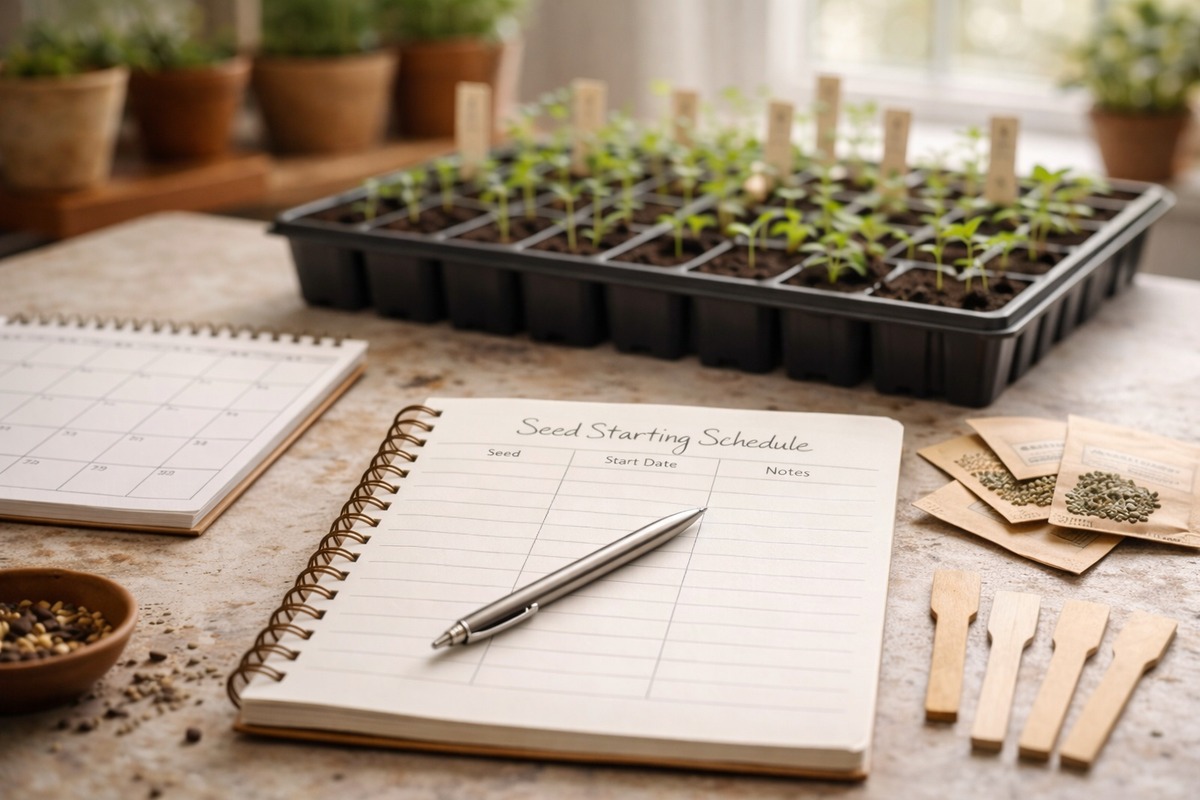
Why seed-starting timing matters (more than fancy gear)
When I’m starting seeds indoors, timing is the difference between seedlings that thrive and seedlings that struggle. If I sow too early, plants can outgrow my space, become “leggy,” and stall after transplanting. If I sow too late, warm-season crops (like tomatoes and peppers) may not have enough time to produce before fall cools down.
The good news: I don’t need perfect precision. I just need a solid system—one that works with my last frost date, the crop’s growth speed, and how I actually garden.
My simple seed-starting timing system
Here’s the method I use every year:
Step 1) Find my local last frost date
I base everything on my average last frost date (spring). It’s more useful than USDA zone for seed-starting timing because frost date tells me when it’s usually safe to transplant tender plants outdoors.
Tip: I treat this date as an average, not a promise. Weather always has the final say.
Step 2) Pick a “target transplant week”
Instead of transplanting on the exact last frost date, I choose a “target week,” depending on the plant:
- Cold-hardy crops (broccoli, cabbage, lettuce): I can transplant 2–6 weeks before last frost (with protection if needed).
- Tender warm-season crops (tomatoes, basil): I transplant around last frost or 1–2 weeks after.
- Very heat-loving crops (peppers, eggplant): I often wait 1–3 weeks after last frost when nights are reliably warmer.
This helps me plan realistically, because my garden doesn’t run on a single calendar day.
Step 3) Count backward using “weeks before transplant”
Seed packets often give “start indoors X weeks before last frost,” but I also use this simple rule:
- Fast growers (cucumbers, squash): start later (3–4 weeks)
- Medium growers (tomatoes): mid-range (6–8 weeks)
- Slow growers (peppers, onions, celery): start earlier (8–12+ weeks)
Step 4) Add a “buffer week” (my secret weapon)
Real life happens. Seeds germinate unevenly. A tray dries out. I get busy.
So I plan in windows, not one exact day:
- I start most crops in a 1–2 week range
- If I’m unsure, I start toward the later side (it’s easier to grow a slightly smaller seedling than a giant indoor plant)
Crop-by-crop indoor seed starting chart (weeks before last frost)
Use this chart as a starting point. I adjust based on my conditions (light, warmth, potting mix, etc.).
Warm-season vegetables
- Tomatoes: 6–8 weeks
- Peppers: 8–10 weeks
- Eggplant: 8–10 weeks
- Basil: 4–6 weeks
- Tomatillos: 6–8 weeks
Cool-season vegetables
- Broccoli: 4–6 weeks
- Cabbage: 4–6 weeks
- Cauliflower: 4–6 weeks
- Kale: 4–6 weeks
- Lettuce: 4–6 weeks (or direct sow)
- Swiss chard: 4–6 weeks
Long-season “start early” crops
- Onions (from seed): 10–12+ weeks
- Leeks: 10–12 weeks
- Celery: 10–12 weeks (slow germination + slow growth)
Cucurbit crops (start late or direct sow)
- Cucumbers: 3–4 weeks (or direct sow)
- Summer squash/zucchini: 3–4 weeks (or direct sow)
- Winter squash: 3–4 weeks (or direct sow)
- Melons: 3–4 weeks
Important note: Cucurbits hate root disturbance. If I start them indoors, I use pots that reduce transplant shock (and I handle them gently).
Which seeds I usually don’t start indoors
Some plants do better when direct sown outside, especially if they grow fast or dislike transplanting.
I usually direct sow:
- Carrots
- Radishes
- Beets (can be transplanted, but direct sow is easier)
- Peas
- Beans
- Corn
- Most “taproot” crops
And for herbs:
- Dill and cilantro often do better direct sown (they bolt fast and don’t love transplanting)
A quick “start date calculator” I use (no math stress)
Here’s my easy planning sequence:
- Write my last frost date on paper (or in a note)
- Choose a crop and find its “weeks before last frost” from the chart
- Count backward by weeks to find my start window
- Circle a range (example: “8–7 weeks before”)
- If I’m starting a lot, I batch by week:
- Week A: onions/leeks/celery
- Week B: peppers/eggplant
- Week C: tomatoes/brassicas
- Week D: cucurbits + quick flowers
That’s it. I don’t overcomplicate it.
Timing tweaks that make a big difference
If my seedlings often get leggy…
Leggy usually means not enough light or too much warmth. In that case, starting slightly later can help because:
- the sun is stronger later in spring
- seedlings spend less time indoors
If my seedlings grow slowly…
That can mean my setup is cool or my light is weak. I either:
- start 1 week earlier, or
- improve warmth/light (even a small change helps)
If I garden in containers or on a balcony…
I can often transplant a bit earlier if I can move pots inside during cold snaps. Mobility is a huge advantage.
Common mistakes I avoid now
- Starting everything at the same time. Different crops grow at wildly different speeds.
- Starting peppers too late. They’re slow early on—starting them earlier helps.
- Starting cucumbers too early. They can become tangled, stressed, and set back hard.
- Trusting the calendar more than the weather. I watch night temps and wind, not just dates.
FAQ
Do I need my USDA zone for seed starting?
Zone is helpful for perennials, but for seed starting, last frost date is usually more useful.
What if I don’t know my exact last frost date?
Even an estimate is enough to start. I use a window and adjust as I learn.
Should I start flowers indoors too?
Some flowers are great indoors (like marigolds and zinnias), but many are easy direct sown. For Seed Starting Basics, I focus on the ones that transplant well and don’t mind indoor life.
Quick wrap-up
When I plan seed-starting timing, I don’t chase perfection—I use:
- last frost date
- a crop chart
- a 1–2 week sowing window
- a buffer week for real life
That system keeps my seedlings healthier and makes seed starting feel simple, not stressful.