
When to Thin Seedlings and How to Do It Without Stressing Them
Thinning seedlings is one of those gardening jobs that sounds simple but feels surprisingly hard the first time. I sow a few extra seeds “just in case,” everything germinates, and then suddenly I have a crowded little jungle in one cell or row. At that point, I know I should thin them, but I hesitate because pulling out healthy seedlings feels wrong.
Still, thinning matters. When too many seedlings share the same small space, they compete immediately. That competition can lead to weak growth, stretching, tangled roots, and plants that never really catch up.
The good news is that thinning is easy once I understand when and how to do it.
Why thinning matters
Every seedling needs light, air, moisture, and root room. When several are packed together, they start competing before they are even established. The result is often thinner stems, slower growth, and more stress overall.
Thinning is not about being harsh. It is about giving the strongest seedling enough space to become a healthy plant.
Why beginners over-sow
This happens for a simple reason: we do not fully trust germination yet. We worry some seeds will fail, so we add more than needed. That is completely normal, especially with tiny seeds.
The problem is not sowing extra seeds. The problem is leaving them crowded for too long.
When to thin seedlings
A good time to thin is after seedlings have emerged and started to show their first true leaves. The seed leaves come first. They are the first simple pair. The true leaves come next and begin to look more like the real plant.
Once I can tell which seedlings look strongest, it is usually time to thin.
If I wait too long, roots begin to tangle and competition increases. Early thinning is easier and gentler than late thinning.
How many seedlings should stay?
In most cases, I want one strong seedling per cell, pot, or final spacing point. That gives the plant room to grow without early competition.
There are exceptions. Some crops are sometimes grown in clusters, and some greens can stay more closely spaced. But for many vegetables and flowers started in cells, one plant per cell is the easiest rule.
Which seedling should I keep?
I keep the healthiest-looking one. That usually means:
- thickest stem
- best color
- most upright growth
- strongest true leaves
- central position if several look similar
I do not need to overthink perfection. I just choose the best candidate and make room for it.
The gentlest way to thin
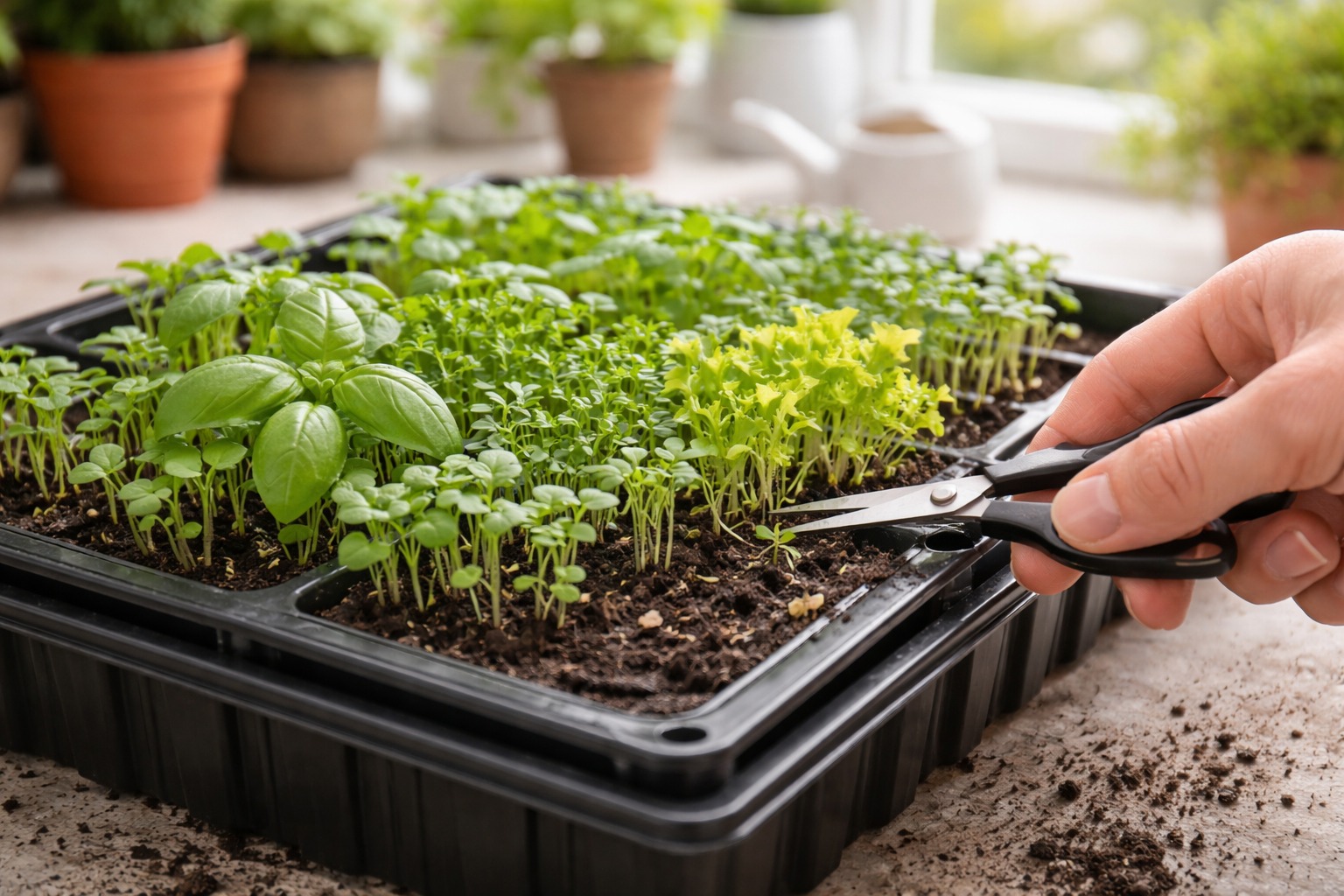
For most indoor seedlings, the easiest method is to snip the extras at soil level with small scissors. This avoids disturbing the roots of the seedling I want to keep.
Beginners often try to pull out extra seedlings by hand. Sometimes that works, but it can also tug on neighboring roots and loosen the one I actually want. Snipping is usually safer.
Can I transplant the extras?
Sometimes, yes. If seedlings are still very young and the roots are not too tangled, I may be able to separate extras carefully and move them into another cell or pot. But this depends on the crop and how crowded things are.
For a beginner, it is often better to view extras as insurance. Once I know which seedling is strongest, I thin and move on rather than trying to save every single one.
How thinning helps prevent problems
Thinning improves more than spacing. It can also help reduce:
- weak, stretched seedlings
- poor airflow
- uneven moisture use
- tangled roots
- plants that stall later
Crowded seedlings look cute for a day or two, but they usually become a problem if I let them stay that way.
Thinning direct-sown seedlings outdoors
The same principle applies outdoors. If I sow lettuce, carrots, radishes, flowers, or beans too thickly, I may need to thin those rows too.
This can feel wasteful at first, but it is usually the difference between a crowded patch of disappointing plants and a cleaner planting with room to perform.
How to make thinning feel less painful
This part is real. Many beginners hate thinning because it feels like throwing away healthy plants. A better way to think about it is this: those extra seedlings already did their job. They gave me insurance and helped make sure I got a good germination result.
Now my job is to choose the strongest one and help it thrive.
Common thinning mistakes
Waiting too long
This is the biggest one. The longer I wait, the more tangled roots become and the harder it is to thin cleanly.
Keeping too many
Sometimes I compromise and leave two or three seedlings because I feel bad removing them. Usually that just leaves me with two or three weaker plants instead of one strong one.
Pulling instead of snipping
Pulling can disturb nearby roots, especially in tight cells.
Thinning before I can judge strength
If seedlings are barely up, it may be worth waiting a little longer until I can see which one looks best.
What crops commonly need thinning?
Many crops may need thinning, especially if I sow more than one seed per spot. Common examples include:
- lettuce
- basil
- tomatoes
- peppers
- brassicas
- zinnias
- carrots
- radishes
- beets
Tiny seeds especially tend to get over-sown.
A simple thinning routine for beginners
Here is an easy approach:
check trays every day once seeds germinate. When most seedlings in a cell have true leaves and I can see which one is strongest, use clean scissors to snip the extras at soil level. Water normally afterward and keep giving the remaining seedling good light.
That is all thinning really needs to be.
Final thoughts
Thinning feels harder emotionally than it is technically. In practice, it is a quick job that helps seedlings grow stronger from the start. Instead of thinking of it as removing healthy plants, I think of it as choosing the one seedling with the best chance to thrive.
A crowded tray might look productive, but one strong seedling in each space will almost always serve me better in the long run.