
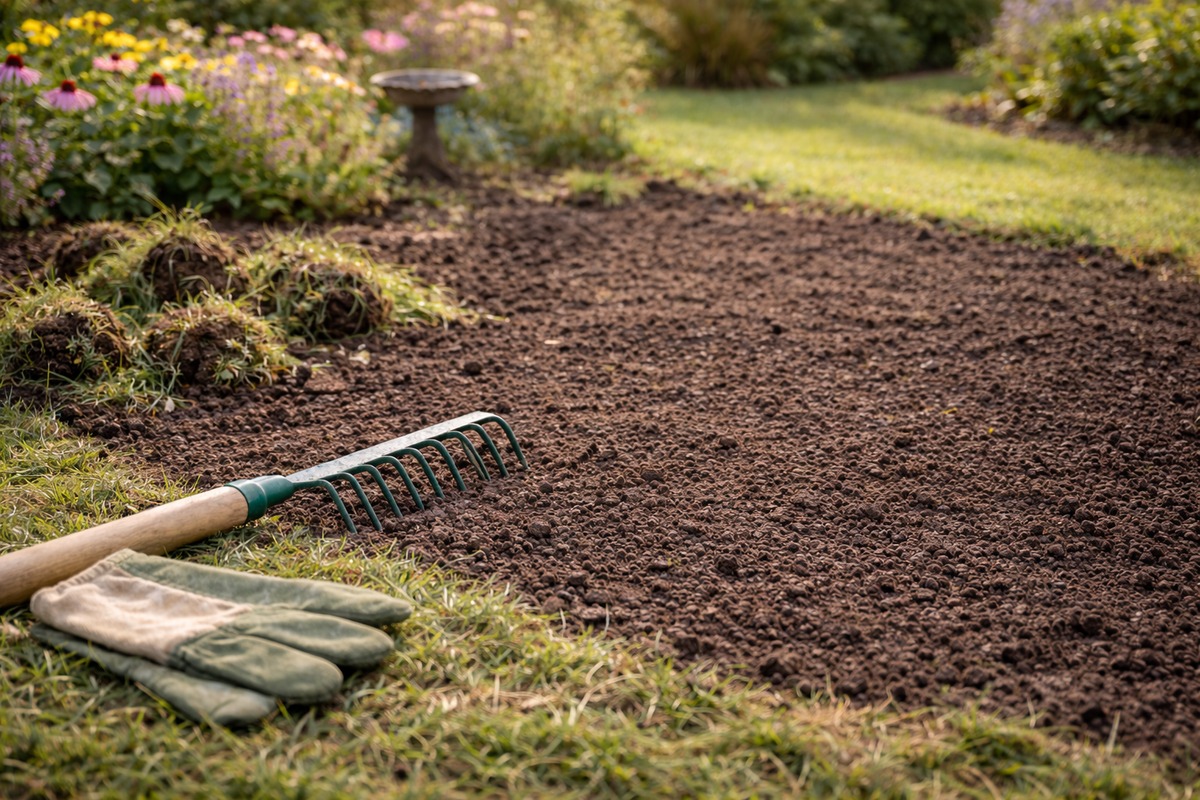
Why prep is the make-or-break step
I can buy the best wildflower seed mix in the world, but if I sow it into a living lawn, the grass wins. Wildflower seedlings are tiny at first, and they can’t compete with established roots.
Good prep gives me:
- better germination (seed touches soil)
- fewer weeds (less competition)
- stronger seedlings (more light and space)
- a patch that looks intentional, not accidental
If I only fix one thing for wildflowers, I fix site prep.
The “soil contact” rule (the simplest concept)
Wildflower seed needs contact with bare soil. That means:
- not sitting on top of thick thatch
- not buried under heavy mulch
- not dropped into tall grass
My goal: at least 50% visible soil before sowing (more is even better).
How to choose a prep method (quick decision guide)
I choose the method based on what’s currently in the area:
If it’s thick lawn grass
Best options:
- smothering (cardboard + mulch)
- sod removal (physical removal)
If it’s weedy but not thick turf
Best options:
- scalp + rake
- shallow scraping of the top layer
If it’s already bare or thin
Best option:
- light raking and leveling
I don’t need fancy tools—just a method that removes competition and exposes soil.
Method 1: Smothering (my favorite “low labor” approach)
Smothering is great if I can plan ahead, because it kills grass/weeds without digging.
How I do it
- Mow the area as low as possible
- Lay down overlapping cardboard (no big gaps)
- Wet it thoroughly so it molds to the ground
- Add a layer of mulch/compost on top to hold it down
- Wait (time does the work)
When it’s ready
When the grass underneath is dead and the surface is mostly soil-like.
Best for: big areas, people who hate digging, long-term prep.
Downside: it takes time and materials.
Method 2: Scalp + rake (fastest for small areas)
This is my “I want to sow soon” method.
How I do it
- Mow very low (or trim)
- Rake aggressively to remove thatch and loosen the surface
- Remove clumps of grass and weeds
- Rake again to expose soil patches
Goal: visible soil + reduced competition.
Best for: small patches, thin lawn edges, quick projects.
Downside: more weed pressure than full removal methods.
Method 3: Shallow scraping (more reliable than it sounds)
If weeds are thick, I scrape off the top layer where roots and weed seeds dominate.
How I do it
- scrape 1–2 inches of surface material (grass + roots)
- rake smooth
- remove debris
- don’t dig deep (deep digging brings up more weed seeds)
Best for: medium patches, stubborn weeds, quick turnaround.
Downside: more physical work, and I need somewhere to put the scraped material.
Method 4: Sod removal (most work, cleanest start)
This gives the cleanest “reset,” especially for turf grass.
How I do it
- cut and lift sod pieces
- remove roots
- rake and level
Best for: small to medium turf areas where I want a very clean seedbed.
Downside: labor-heavy.
The “weed seed bank” problem (and how I reduce it)
Even after I remove grass, weed seeds are already in the soil. If I disturb soil too deeply, I bring up more seeds.
So my approach is:
- disturb soil as little as possible
- focus on surface prep + seed contact
- control weeds early after germination
How I create a good seedbed (after removal)
Once the grass/weeds are reduced, I do a simple seedbed finish:
- Rake the area lightly to loosen the top 1 inch
- Break up clumps (tiny seeds hate big clods)
- Level the surface so water doesn’t run channels
- Remove sticks/roots that prevent seed contact
I’m not making a “garden bed.” I’m making a seedbed.
Should I add compost or soil amendments?
Most wildflowers don’t need rich soil. In fact, overly rich soil can:
- favor weeds
- produce floppy growth
- reduce flowering in some species
If my soil is extremely poor or sandy, I might add a small amount of compost—but I keep it minimal.
My rule: prep for seed contact, not fertility.
Sowing tips that work better after good prep
- mix seed with sand for even coverage
- broadcast in two directions
- press seed into soil (critical)
- don’t bury deep
- water gently during establishment
Prep makes all of these steps more effective.
After sowing: what I do in the first 4 weeks
Week 1–2
- keep the surface lightly moist
- watch for the first tiny sprouts
- don’t disturb the area
Week 3–4
- water less often but deeper
- start pulling obvious aggressive weeds
- avoid hoeing or deep raking (disturbance brings up more weed seed)
Early weed control matters most before wildflowers build size.
Common prep mistakes I avoid now
- sowing into existing lawn “to see what happens”
- covering seed with thick mulch
- digging deep and bringing up fresh weed seed
- skipping leveling (then seed washes into piles)
FAQ
Can I just sprinkle wildflower seeds on grass?
I can, but results are usually poor. Some seeds may grow, but it’s inconsistent and weeds/grass win.
Do I need to till?
Not usually. Tilling can bring up more weeds. Light raking is often enough if the surface is prepared well.
How long should I smother before planting?
It depends on season and conditions, but it’s ready when the grass/weeds underneath are dead and breaking down.
Quick wrap-up
Wildflower success starts before I sow:
- remove grass and weeds
- expose soil
- keep disturbance shallow
- press seed into the surface
- control weeds early
If I prep well, everything else gets dramatically easier.